Territorio no Incorporado

“Territorio no Incorporado”: Progress Reports 1-2

Throughout this phase in the creation of the “Territorio no Incorporado” prototype, I have experienced a series of successes and challenges. In essence, I have come to appreciate the many approaches to devising a cohesive plan for developing narrative interpretation and user workflows. Course readings and sample websites have provided me with interpretive lenses to…
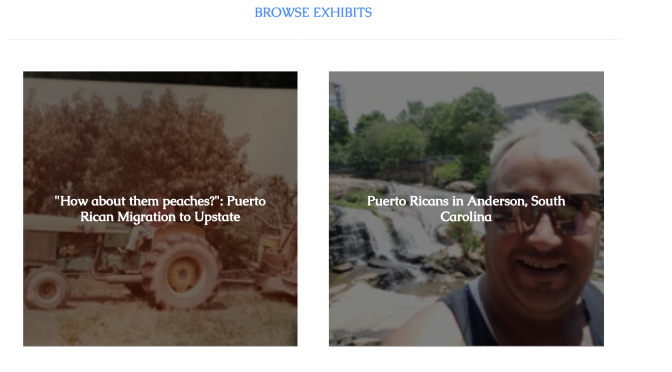
Project Proposal: “Territorio no Incorporado”

Nature of Project Puerto Rican populations are in continued dispersion across state lines, flowing out of the largest Northeast urban regions and mid-size cities to the Southeast. With 117% growth, South Carolina has become one of the fifteen states with the fastest growth in Puerto Rican population in the past 20 years. The Upstate region in…

Digital Public History Project: Personas Revised

Persona 1: The Foodie-Traveler-Buddy Name: Julio Demographic profile: Julio is a 44-year-old, single, Puerto Rican-born male. He’s an educated, high-producing hairstylist at a salon in the Upstate. Quote: “I’ll pick a place I’ve never been in the Upstate, a Latino place. I’m always seeking new friends and good food” A Day in a Life Narrative: …

Audience-Content Relationships in Public History Projects

Paving New Digital Dialogic Pathways for Audience-Content Engagement The ultimate aim of designing a public history platform, such as “Territorio no Incorporado”,  is to generate a dialogical and reflective virtual map that would help visualize the unincorporated nature of the Puerto Rican “territory”. Using this legal unterritoriality nomenclature as the framing device for the project…

Comparative Review of Two Public History Exhibits by the Atlanta History Center: Cyclorama: The Big Picture (Physical) & More than Self: Living the Vietnam War (Digital)

Physical Exhibit: Cyclorama: The Big Picture Location: Atlanta History Center Historical Argument The overarching argument of The Battle of Atlanta 360° Cyclorama Exhibit was clearly displayed on a large screen, the moment visitors set foot on the exhibit space: “there are voices that are not heard”,  “arts and entertainment promote myths”, and “The Atlanta History…

Audience-Content Relationships in Digital Public History Projects

The professionalization  of the public historian and audience-content creation: A Tale of Two Fronts Scholars in the realms of public history agree on the complexities and debates involved in defining the concept public history. The lack of consensus as to what is and who does public history has proven to have direct impact over audience-content…

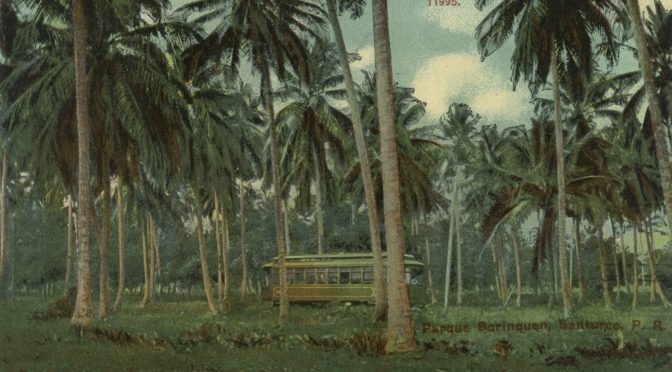
View of Santurce, PR. Lithographic postcard. Creator, Gonzalez Padin, Hnos. Contributors, Gleach/Santiago-Irrizarry.

Doing Digital Humanities: A Reflection from a Newbie

Aim of EnRoutes With EnRoutes: Markers & Makers in 1900s’ Puerto Rico, I wanted to create a space where the audience can establish relationships with visualized images and annotations. I have great interest in how road system projects that took place in 1900s transformed social networks in Puerto Rico. In Puerto Rico, considered to be…

Social Media Strategy for EnRoutes

The EnRoutes Project En Routes: Markers & Makers in Early 1900s’ Puerto Rico will be launched as a space where audiences can establish relationships with images and literary text excerpts. I would like to share my interest in how road system projects that took place in 1900s transformed social networks in Puerto Rico. I envision…

Crowdsourcing Cultural Heritage: A Comparison of Four Cases

What is Crowdsourcing Cultural Heritage? Crowdsourcing is to take projects created by institutions or  organizations and to outsource tasks to the general public. Wikipedia is the most well-known case of crowdsourcing.  It typically involves a project generated by a museum, a library, an archive, or a gallery (GLAM). Project designers will digitize large amounts of…